

 Change.gov Change.gov |

  |
| Change.gov |
 Nov 7 2008, 06:55 PM Nov 7 2008, 06:55 PM
Post
#31
|
|
 DEATH TO ....something? Group: Members Posts: 5,618 Joined: 23-February 06 From: Parker, CO Member No.: 55  |
QUOTE (Billy @ Nov 7 2008, 06:36 PM)  Heavy trucks damage the roads far greater than light cars. Simple fatigue analysis. Any engineer can you tell you that. Not only that, but roads and bridges have to be designed for the greater weight of trucks, thus increasing the cost of building roads. So there is a vast amount more usage of the roads of non-DOT vehicles, meaning vehicles with a GVWR of less than 10,000 lbs. Anything 10k or over you have to have a CDL to legally operate on public roads. A fully loaded semi truck is bound by law to be less than 80,000-lbs gross without an overload permit, so I'm going to use this as a base number. I'm going to assume the average weight of a passenger car is 3500-lbs. I am going to assume that the average contact patch for non-DOT vehicles is a 6.5" wide tire, and a 24" diameter. So, just for the hell of it, let's assume a contact area of 6.5"x4"x4. 104" in^2 x 3500-lbs = a stress of 33.65 psi exerted on the roadways. Now, for the hell of it, lets take that stress exerted on the roadways times the number of miles driven ... 33.65 psi x 1,682,671 Mmiles = 55,621,879 psi*Mmiles Now let's do the same thing to come up with a represenative "damage factor" for DOT vehicles. A semi tire is approximatley 11" wide by 38" in diamater. Let's assume a contact area of 11x8x10 (tractor) + 11x8x8 (trailer) ... 18 total wheels, for a total area of 1584 in^2. 80,000-lbs / 1584 = 50.5 psi. Let's apply our 'damage factor' calculation. 50.5 psi x 80,331 Mmiles = 4,056,715 psi*Mmiles Damage factors: Passenger cars - 55,621,879 psi*Mmiles DOT vehicles - 4,056,715 psi*Mmiles Pcar / Dot Damage ratio ------ 13.7 x more stress on roadways due to passenger cars than DOT rigs. Thank you drive thru! -------------------- I r Ur Gawd!
|
 |
 
|
|
Nov 7 2008, 06:58 PM
Post
#32
|
|
 N 0 t h i n g Group: Members Posts: 1,449 Joined: 23-February 06 Member No.: 54 |
Besides the fact your numbers are complete bullshit and any retard can make that stuff up....
That is NOT how you calculate fatigue. One last note, we're going to ship a manifold that weighs 240,000 lbs. Again, the roads have to be built to withstand that. Yet, I don't see cars out there driving around weighing anything near that. --------------------  QUOTE (jonathan83 @ Nov 16 2007, 09:22 PM) |
|
|
|
|
Nov 7 2008, 06:59 PM
Post
#33
|
|
|
DEATH TO ....something? Group: Members Posts: 5,618 Joined: 23-February 06 From: Parker, CO Member No.: 55 |
QUOTE (Billy @ Nov 7 2008, 07:58 PM) Besides the fact your numbers are complete bullshit and any retard can make that stuff up.... One last note, we're going to ship a manifold that weighs 240,000 lbs. Again, the roads have to be built to withstand that. Yet, I don't see cars out there driving around weighing anything near that. No, those numbers aren't complete bullshit you fucking moron. Look it up. And if you're shipping a manifold that weighs 240,000-lbs I gauren-damn-tee you you have to have a special permit for that as well as pilot cars and the whole getup. I'm sure you know all about shit like this sitting in your comfy downtown Houston office 
-------------------- I r Ur Gawd!
|
|
|
|
|
Nov 7 2008, 07:00 PM
Post
#34
|
|
 Oh baby bring me down  Group: Agents Posts: 4,115 Joined: 23-February 06 From: Way out yonder Member No.: 68 |
You know, there is static sheer and dynamic sheer!
-------------------- Southern Rock, beer and bears!
 |
|
|
|
|
Nov 7 2008, 07:01 PM
Post
#35
|
|
|
Fool Group: Members Posts: 2,127 Joined: 23-February 06 From: LBB Member No.: 56 |
QUOTE (Billy @ Nov 7 2008, 06:36 PM) Heavy trucks damage the roads far greater than light cars. Simple fatigue analysis. Any engineer can you tell you that. Not only that, but roads and bridges have to be designed for the greater weight of trucks, thus increasing the cost of building roads. Here's some perspective: Average weight of a car: 4500 lbs Average weight of one our manifolds that we ship via road: 145,000 lbs. But the little passenger cars have to pay much more than they should have to so that the roads can handle in excess of 145,000 lbs. And how much does that manifold lower the fuel efficiency of the truck hauling it? So how much more fuel does it consume on that trip compared to the fuel it would consume on a trip with a "normal" load? -------------------- Spam? Isn't that something poor people eat?
|
|
|
|
|
Nov 7 2008, 07:03 PM
Post
#36
|
|
|
DEATH TO ....something? Group: Members Posts: 5,618 Joined: 23-February 06 From: Parker, CO Member No.: 55 |
QUOTE (James @ Nov 7 2008, 08:01 PM) And how much does that manifold lower the fuel efficiency of the truck hauling it? So how much more fuel does it consume on that trip compared to the fuel it would consume on a trip with a "normal" load? that truck isn't going faster than 30 mph most likley hauling that. I see semi trucks hauling nearly 1,000,000-lb completley assembeled compressor stations fairly regularly, albeit at about 4 mph .. Complete with pilot cars AND local law enforcement as escorts. You aren't moving something that weighs that much on a whim. -------------------- I r Ur Gawd!
|
|
|
|
|
Nov 7 2008, 07:04 PM
Post
#37
|
|
|
Fool Group: Members Posts: 2,127 Joined: 23-February 06 From: LBB Member No.: 56 |
Not sure what numbers you used for total mileage, but to be consistent with my tax values, suggest using 2,784,085,000,000 miles driven by "Passenger" vehicles versus 223,037,000,000 miles driven by "Trucks".
-------------------- Spam? Isn't that something poor people eat?
|
|
|
|
|
Nov 7 2008, 07:06 PM
Post
#38
|
|
|
DEATH TO ....something? Group: Members Posts: 5,618 Joined: 23-February 06 From: Parker, CO Member No.: 55 |
QUOTE (James @ Nov 7 2008, 08:04 PM) Not sure what numbers you used for total mileage, but to be consistent with my tax values, suggest using 2,784,085,000,000 miles driven by "Passenger" vehicles versus 223,037,000,000 miles driven by "Trucks". I just picked the numbers you posted in that earlier reply .... I just needed a number to contrast what I am calling a "damage factor" with. QUOTE It was said trucks use the roads a lot more though. 80,331 million miles for trucks versus 1,682,671 million miles travelled by passenger cars. Trucks account for 4.6% of total mileage on roads yet pay 13.0% of the total fuel taxes. I'm not claiming those numbers I threw out there are accurate to a high degree, it was just something I put together to show the concept. -------------------- I r Ur Gawd!
|
|
|
|
|
Nov 7 2008, 07:10 PM
Post
#39
|
|
|
Fool Group: Members Posts: 2,127 Joined: 23-February 06 From: LBB Member No.: 56 |
I see. Revised as follows:
Damage factors: Passenger cars - 93,684,460 psi*Mmiles DOT vehicles - 11,263,369 psi*Mmiles Pcar / Dot Damage ratio ------ 8.3 x more stress on roadways due to passenger cars than DOT rigs. Not as much, but still in more. The later numbers are definitely accurate for 2006. I'm sure everything's gone up for 2008, including the ratio of diesel tax to gas tax since the price difference is so great. -------------------- Spam? Isn't that something poor people eat?
|
|
|
|
|
Nov 7 2008, 07:11 PM
Post
#40
|
|
|
N 0 t h i n g Group: Members Posts: 1,449 Joined: 23-February 06 Member No.: 54 |
QUOTE (Dogmeat @ Nov 7 2008, 06:59 PM) No, those numbers aren't complete bullshit you fucking moron. Look it up. And if you're shipping a manifold that weighs 240,000-lbs I gauren-damn-tee you you have to have a special permit for that as well as pilot cars and the whole getup. I'm sure you know all about shit like this sitting in your comfy downtown Houston office Do you know anything about Cameron?.... And yes, your numbers are bullshit and that's not how you calculate fatigue. I'm glad you're not above stooping to educational dishonesty to try to win an argument. For those of you who don't know how to calculate fatigue, I give you exhibit 1: 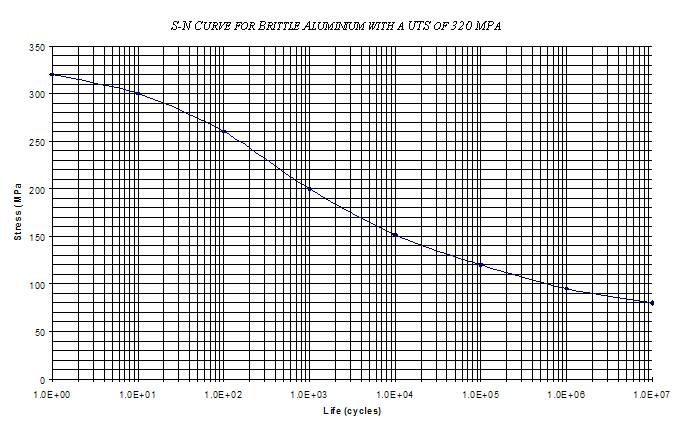 This is a fatigue curve, or stress vs cycles. The way this works, is that each time you cyclically stress something, by applying a load, the material's strength is reduced. As a material's strength is reduced, it takes less stress to make that material yield/plastically deform/fail. In this curve, Al can handle a load of 320 MPa before failure. However, if you apply less than that, Al will not fail. However, it's strength will be reduced so that next time, you might apply less than 320 MPa but it will still fail. Equipment can be designed to never fail. For instance, if I apply only 50 MPa to this specimen, it will have infinite life. No matter how many times I apply that load, it will never fail. Any time I apply a load above it's infinite life threshold, which in this graph appears to be around 80 MPa, it makes the curve more steep which means I have permanently fatigued the specimen. The more stress you apply to a material, the more you fatigue it, thus permanently weakening its ability to resist yielding. To make a long story short, a car applying it's load to a road designed to handle a 250K lbs of load will not fatigue the road anywhere near a truck with a 140,000 lb equipment loaded on it will reduce the strength of that road. Roads would need very little repair if it were not for trucks. So in order for Dogmeat to calculate the "Damage factors" he would have to know the yield strength and ultimate strength of the road, which he does not. And thus, everything he did means absolutely jack shit. So please do not buy into his nonsense. His math says nothing, other than he makes up numbers to confuse you into thinking he knows something. -------------------- QUOTE (jonathan83 @ Nov 16 2007, 09:22 PM) |
|
|
|
|
Nov 7 2008, 07:24 PM
Post
#41
|
|
|
Fool Group: Members Posts: 2,127 Joined: 23-February 06 From: LBB Member No.: 56 |
Yes, trucks definitely put more wear on the road, but roads, such as interstates, are designed to take the continual load, much like your aluminum cylinder takes the 50 MPa load forever. When they rebuild an interstate in Texas, they do so such that it can last 30 years. So I guess the real question is how much of that mileage is on interstate vs non-interstate? How many of those miles are with loads above deform/fail levels? For that, I don't see any data and if there is, I definitely don't want to pick it apart.
The thought of taxing the trucking industry more doesn't sit well because they're not going to just sit down and shut up; they're going to raise prices and pass it on to the consumer or they're just going to stop moving goods. Neither sounds appealing to me. -------------------- Spam? Isn't that something poor people eat?
|
|
|
|
|
Nov 7 2008, 07:26 PM
Post
#42
|
|
|
N 0 t h i n g Group: Members Posts: 1,449 Joined: 23-February 06 Member No.: 54 |
QUOTE (James @ Nov 7 2008, 07:24 PM) Yes, trucks definitely put more wear on the road, but roads, such as interstates, are designed to take the continual load, much like your aluminum cylinder takes the 50 MPa load forever. When they rebuild an interstate in Texas, they do so such that it can last 30 years. So I guess the real question is how much of that mileage is on interstate vs non-interstate? How many of those miles are with loads above deform/fail levels? For that, I don't see any data and if there is, I definitely don't want to pick it apart. The thought of taxing the trucking industry more doesn't sit well because they're not going to just sit down and shut up; they're going to raise prices and pass it on to the consumer or they're just going to stop moving goods. Neither sounds appealing to me. Yes, but you have to design the roads so that the trucks do not fatigue them, which if they didn't have to, the roads would be exponentially cheaper to build. We as a society benefit though from shipping. So I am not complaining about paying the tax. But to say only citizens use the roads, like Hartman claimed, is not only ignorant, but insanely far from the truth. -------------------- QUOTE (jonathan83 @ Nov 16 2007, 09:22 PM) |
|
|
|
|
Nov 7 2008, 07:33 PM
Post
#43
|
|
|
DEATH TO ....something? Group: Members Posts: 5,618 Joined: 23-February 06 From: Parker, CO Member No.: 55 |
QUOTE (Billy @ Nov 7 2008, 08:11 PM) Do you know anything about Cameron?.... And yes, your numbers are bullshit and that's not how you calculate fatigue. I'm glad you're not above stooping to educational dishonesty to try to win an argument. For those of you who don't know how to calculate fatigue, I give you exhibit 1: This is a fatigue curve, or stress vs cycles. The way this works, is that each time you cyclically stress something, by applying a load, the material's strength is reduced. As a material's strength is reduced, it takes less stress to make that material yield/plastically deform/fail. In this curve, Al can handle a load of 320 MPa before failure. However, if you apply less than that, Al will not fail. However, it's strength will be reduced so that next time, you might apply less than 320 MPa but it will still fail. Equipment can be designed to never fail. For instance, if I apply only 50 MPa to this specimen, it will have infinite life. No matter how many times I apply that load, it will never fail. Any time I apply a load above it's infinite life threshold, which in this graph appears to be around 80 MPa, it makes the curve more steep which means I have permanently fatigued the specimen. To make a long story short, a car applying it's load to a road designed to handle a 250K lbs of load will not fatigue the road anywhere near a truck with a 140,000 lb equipment loaded on it will reduce the strength of that road. Roads would need very little repair if it were not for trucks. So in order for Dogmeat to calculate the "Damage factors" he would have to know the yield strength and ultimate strength of the road, which he does not. And thus, everything he did means absolutely jack shit. So please do not buy into his nonsense. His math says nothing, other than he makes up numbers to confuse you into thinking he knows something. Welp, I'll thank you for giving me a review of an S-N curve. And you are correct. So ... do you happen to know what the S-N curve for a composite material looks like? -------------------- I r Ur Gawd!
|
|
|
|
|
Nov 7 2008, 07:48 PM
Post
#44
|
|
|
I was raised on the dairy, BITCH! Group: Members Posts: 3,080 Joined: 23-February 06 From: Cedar Park Member No.: 49 |
frankly a lot of this talk is pointless
look forward to higher taxes all around because when a dem gets into office and a dem controlled congress they'll want more government which means more taxes we just have to buckle down and hope the next 4 years won't end us -------------------- "Ah, y'know it's funny, these people they go to sleep, they think everything's fine, everything's good. They wake up the next day and they're on fire."
|
|
|
|
|
Nov 7 2008, 07:49 PM
Post
#45
|
|
 GORILLA FLUFFER Group: Agents Posts: 7,711 Joined: 23-February 06 From: lubbock Member No.: 50 |
QUOTE (pysex @ Nov 7 2008, 07:48 PM) frankly a lot of this talk is pointless look forward to higher taxes all around because when a dem gets into office and a dem controlled congress they'll want more government which means more taxes we just have to buckle down and hope the next 4 years won't end us or, hope it DOES end us, and we take the rest of the world with us..... set us back to the dark ages... heh --------------------  QUOTE (Jessica @ May 7 2007, 01:15 PM) but yeehaw dammit. YEEHAW QUOTE (Dogmeat @ Jun 26 2008, 07:51 PM) ok once upon a time I jacked myself off retarded. Licking anuses, one kindergarten class at a time!! |
|
|
|
|
| Lo-Fi Version | Time is now: 23rd September 2026 - 08:09 AM |


